Tuesday, May 12, 2009

Lynn Hershman (Artist Post #11)


Lynn Hershman

I really find Lynn Hershman’s work interesting because of the ideas she fuses together in her photography and in her use of Photoshop. In The San Jose Museum of Art, San Jose, May 10, 2008 - August 30, 2008, her gallery has a theme of fusing human images with materialistic objects. The way in which the objects are fuse make me think of Lynn Hershman as an artist making a statement about the certain objects used. For instance, in the picture entitled “Seduction” there lays a women on the bed in a seductive pose, but with a TV instead of a head and face. Perhaps what Hershman is trying to convey to her audience is that we a society put too much emphasis on things that should be personal, like love and sexuality, on forms of media such as the television.
While I have seen some of her work in photography, video, installation, interactive, and Net-based works, the part that I found most intriguing were pieces of her photography. Her 53 videos and seven interactive installations have won many international awards. In 1995, she was the first woman to receive a Tribute and Retrospective at the San Francisco International Film Festival, and in 1994, she was awarded (with director Peter Greenaway and theorist Jean Baudrillard) the Siemens Media Prize by the ZKM. In 1998, she was a Sundance Screenwriter Fellow and was honored with the Flintridge Foundation Award for Lifetime Achievement in the Visual Arts. In 1999 she received the Independent Spirit Award, and the prestigious Golden Nica Prix Ars Electronica.
Her project challenges the legality of genetic DNA ownership by creating a virtual entity comprised of the aesthetics, experiences, and interests of users. This "tamagochi-like" creature will be an Internet-bred construction of identity that will flesh out through cumulative virtual use, reflecting the global choices of Internet users. This could perhaps be an extension of her work during a furture exhibit, furthering the idea of technology fused with the human body and experiences.

Sunday, April 19, 2009

Yeas and Nays (Artist post #10)

Christian Croft: Yeas and Nays (Artist post #10)

Digital artist Christian Croft has designed a new, innovative and exciting way to get people more involved in their government. He created a widget that can connect to any cellphone, which connects calls to a website of supports of the democratic process. On the layout of his site called “shiftspace.org” there is a video in which Christian Croft himself goes into detail about how to use the widget, making call to his own senator and displaying the MP3 recorded by the widget that he created himself, on the website so that his answers (or lack thereof) are displayed for all of the yayers and nayers to see. “Yeas and Nays is a space that transforms any webpage into a means for contacting Congressional representatives. Using Yeas and Nays, a citizen can connect via phone to speak with her representatives, and the resulting shift keeps a record of the call located on the website that informed it.”


The site has 10 easy steps for using the widget:
1. Install the space through the settings>Spaces tab by typing ‘YeasAndNays’ in the ‘install a space’ text box.
2. Initiate the space by pressing the [Shift] key, move your mouse over the [+] icon and click on the YeasAndNays icon.
3. The YeasAndNays widget will appear on the screen where you summoned it.
4. Enter your zipcode in the widget to look up your corresponding Congressional representatives.
5. Choose the Congress person you wish to call and enter your phone number.
6. Check the box that says you agree to YeasAndNays generating a call that bridges your phone to your Congress person’s office. Then choose whether or not you want to record your call so that others can listen to it on ShiftSpace.
7. Have your phone ready and click the “Call Now & Connect Me” button. Your phone will receive a call almost instantaneously.
8. An automated YeasAndNays phone menu will greet you and instruct you to press 1 on your phone keypad to connect to your Congress person’s office.
9. Once your call is bridged, talk to the representative about your issue. Try to use information on the webpage and refer to your talking points to support your cause.
10. After your call is finished, the YeasAndNays shift will update and tell you that your call is completed. If you chose to record the call, then you can listen to an mp3 of it now.
11. Your YeasAndNays shift is automatically saved once your call has been completed. At this point, other ShiftSpace users can see your shift and listen to your phone call to your Congress person.

I personally think Christian Croft’s ideas are interesting and decided to write about it because of how it responds to the general lack of interest that the public has in current politics. Crofts widget is a cool way to keep people connected and interested in what is going on in the public sphere, as well as making contacting and making your voice heard in this democracy.

Tuesday, April 7, 2009

Mouchette- Artists I plan on Incorporating-5


Mouchette- Artists I plan on Incorporating-5

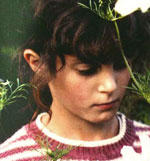
The journey that Mouchette takes us through on the website is that of a thought process, and that is what I plan on making my final project structured around. Mouchette.org is an interactive website created in 1996 by a pseudonymous character, an Amsterdam-based artist who calls herself "Mouchette". With her innocent salutation and claims to be "nearly thirteen"[1] greeting us from the introduction page, what initially appears as a personal website of a pre-pubescent female artist, evolves into darker themes in the subsequent pages. Mouchette is loosely based on 1937 book by Georges Bernanos and the 1967 Robert Bresson movie, Mouchette. The storyline is about a French teenager who commits suicide after she is raped. An online quiz comparing the “Neo-Mouchette”[2] to the movie angered Bresson's widow, so she threatened a law suit against the artist behind the project. The quiz was taken down after that incident.[3] [4][5] The creator of the website has been closely guarded secret[3]. While the use of taboo subject matters are what initially "provokes heated reactions"[3], the manipulation of cyber identity[3] and the ability of the creator to maintain anonymity for so long are the significant reasons this website has garnered its “international reputation”[5] in the Internet Art community.

SHU LEA CHEANG (atleast from the website)- Artists I plan on Incorporating-4

This montage was created based on the true story of Teena Brandon, a 21-year-old woman who in 1993 was raped and later killed for passing as a man, fascinated film-going audiences when Hillary Swank portrayed her in "Boys Don't Cry" (1999). A year earlier, the Guggenheim Museum in New York commissioned Taiwanese-American artist Shu Lea Cheang to make Brandon, a Web-based art work (the first commissioned by the Guggenheim) that explores Teena Brandon's story in an experimental, non-linear way, conveying the fluidity and ambiguity of gender and identity in contemporary societies. I found it on the Shu Lea Cheang website. I plan on incorporating several collages, to some extent like this one, in order to portray different stages of life. I plan on creating links to minor parts of the collages that connect the piece back into a part of the larger scope of the project.


Juha Huuskonen- Artists I plan on Incorporating-3


Juha Huuskonen- Artists I plan on Incorporating-3

I really like the constant interactions apparent within Juha Huuskonen’s work in the piece entitled “doublecell.” The piece is really cool because it consists of basically one frame which repeats itself based on user interactions within the piece. I like the fact that in concept it seems very simple that really isn’t. The interactivity drives the piece, and urges the user to continue on further and further. I got almost obsessed with finishing each interaction within the series. I spent a lot of time connecting the battery cells they just keep repeating. Something that I didn’t notice about the piece at first was the little revolving circle that moves faster as the user responds to the piece.


When I experienced doublecell: “Bob meets Barbra” I was drawn into it. I spent quite an amount of time just working with the tiny aspects of it until I realized just how much time I had actually spent working on it. I think this would be a great way of getting people interested and invested within my final project piece. I want it, overall, to be a piece that is user based and that responds to the users choices. I plan on utilizing game style interaction like Juha Huuskonen does in doublecell: “Bob meets Barbra” within my piece in order to further get the user involved. So that my final project will be one in which the user is constantly involved and not one that they merely look at and experience. Ii think I’ll probably incorporate these minor visualizations through interactions with buttons in my piece.

Monday, April 6, 2009

Final Project- Artists I plan on Incorporating-2

Artists:
M. River & T. Whid
Art Associates


When I first dicovered M. River and T. Whid's work, it made me laugh. I really enjoyed their projects because of how they incorporated realism and drew me into their world. It makes the viewer part of the project, part of the peice. While I don't plan on incorporating camera footage of myself into the video, I do plan on making interaction through things like buttons and settings that M. River and T. Whid use in many of their projects.


MTAA (M. River & T. Whid Art Associates) is a Brooklyn, New York-based conceptual and net art collaboration. MTAA is also a real-time performance played out on the Internet, in physical installations, through print media, documentation, and miscellaneous ephemera. Using aspects of conceptual art, popular culture and real-time performance, MTAA’s work seeks a new manner of dialogue between artist and audience. Find MTAA's online artwork and documentation at MT Enterprises WorldWide. (http://mteww.com/)

Sunday, April 5, 2009

Revise and Resubmit. (Artist Post #9)

KERRY JAMES MARSHALL (Artist Post #9)

I plan on incorporating part of the ideas that I found while researching this author into my final project. I think he is also relevant to our class however, because of the way in which he completes his work. Kerry James Marshall is a contemporary artist, a painter to be exact. He has done a great many variations of work and conceptual ideas. The one in particular that I felt went along with some of the stuff we were doing in class is entitled “Momento.” On the SFMOMA site, I saw a video in which he was discussing the creation of his work and how he came to the final product after much reflection. “Momento” is mainly a piece of artwork that is based significantly around the time period in which it was first created. When Marshall first created it, he made it as vivid and extravagant as possible. After looking back on his work he realized that the piece was not what he wanted. He even states in the video that he was unhappy with how “ostentatious” the piece seemed to him. The original had a variety of colors and even gold glitter. It is a piece depicting the family life in the 1920s of a black family and what they hold dear to them. In the video, Marshall reflects upon his choices to incorporate so many colors into his artwork. He was reflective on the time period he was trying to convey within the piece and then found that he would be happier creating the piece in black and white, using grayscale to still have impacted colors. I think that this holds particular significance to what we recently discovered in class during the critiques of our final projects. Artwork can always be changed, tweaked- and made different- to better convey the fundamental ideas that made us start drawing- or in our case, flashing.