Thursday, February 26, 2009

Alessandro Bavari (Artist Post #5)

Alessandro Bavari was born in 1963 in Latina, a town bordering the cost on the south of Rome, Italy where he grew up as a member of an Italian-French family. Alessandro Bavari's work is directly correlated with two of the artist I have previously decided to blog about. Although his work is in the same vein as Jacqueline Hayden or even Fran Herbello, there are some stark differences between the two. For one thing, there is nothing subtle about Alessandro Bavari's work. Unlike some of the other artist that I have posted on, he does not attempt to merge seamlessly the pieces of fiction and reality within his work. His pieces are whimsical yet somehow disquieting. The masculine face on the somewhat feminine body in his first piece contrast with one another sharply, leaving me to question what his purpose of doing so was. Also, the distorted bodies of the figures in the background are in stark contrast with their blunt sinister facial expressions. Bavari mismatches everything from focus to our preconceptions of what fantasy is and how reality comes into play within that notion.
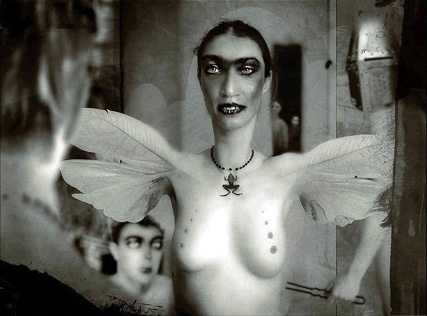
Throughout his career Bavari has taken several photographs of people, animals, objects, architecture, landscapes, and fossils. He uses these images as the toolbox for his work, which is greatly influenced by “Indo-European cultural myths and allegories.” His pieces merge several different photographs together. It makes me wonder whether or not Photoshop is the only thing he uses in his creations, and what inspires him to create such odd collages of the separate mosaic photographs that he has taken. His manipulation of many of his own original photographs creates a narrative that he takes as a description of “unconscious urges and desires.”
I’m not quite sure what the urges and desires of the Portrait of nymphomaniacs in Gommorah is exactly attempting to portray, (possibly sex and the desire to fly?), but I found his work to be interesting all the same. I can’t wait until we get started with Photoshop in class! If nothing else, I admire how Bavari’s work is distinctly his unique expression of human desires- he took his own photographs and merged them in photo processing software to create his own inimitable visions.

Thursday, February 19, 2009

What I've got so far!! Please comment.

http://students.smcm.edu/rnali/lovestory.html

Wednesday, February 18, 2009

"Roy Rules. It would be a 24/7 96" (Artist Post #4)

Simen Johan creates a situation in his photography that forces the audience to implicate and use their own experiences as a way of getting into what the piece really means. The first piece that I viewed of Johan’s work was entitled “#96”. I think the anonymity of the piece adds to the artist’s intention of leaving interpretation up to that of the viewer. Usually artist name their artwork, whether it be for symbolic or simply categorization purposes. Johan, however, refuses to do so, and therefore creates only a picture which we must decipher.
Number 96 shows a disorderly un-kept while girl with a bag over her head and an arrow in her left hand. In front of her lies, what seems to me, a bald eagle. She is surrounded by walls that were once white but now remain beaten, scratched and graffitied with monsters and other whimsical characters, along with numbers written backwards. To me, personally, the artwork symbolizes the death of the innocence and purity of a nation, preferably the United States because of the implications that a bald eagle holds as our national bird. The dirtied girl with a bag over her head seems to beg for sympathy and help, as she seems to wither away. The girl can also be seen as responsible for the nation’s death, mostly because of the arrow in her hand, yet she seems blind because of the bag, and helpless because of the daunting walls of horror that surround, entrap and somehow torment her.
Through his photography, Simen Johan questions his viewers and creates “narrative possibilities and allegories that appear vaguely familiar and produce numerous associations” (Johan). Johan further states that it is his hope to “to seduce viewers into letting their experience, imagination, and understanding of existing popular narratives create their own interpretations of my images.” I love the mystifying effect that it creates in and of itself.


"Number 96"

Monday, February 16, 2009

Disturbia (Artist Post # 3)

Jacqueline Hayden

When I saw the disturbing artwork of Jacqueline Hayden I was immediately reminded of the most disturbing scenes that are frequent in horror films. Looking through some of the pictures posted on the Alternative Museum’s website, I began to wonder what it is about the art that is so disturbing. Her art is very realistic and appears to the viewer to be an actual human, at least the photographed work. When I saw her sculpture on the pedestal, it gave her artwork an entire different look and feel. To see people looking up at the piece put things in a new perspective and made the artwork seem somewhat powerful. Staring up at a grotesque human body I think says a lot about a society’s standards and views on culture.
Jacqueline Hayden considers her work creations of digital composites which are photographs of older figure models and photographs made of ancient statuary in situations that usually significantly engage the visual history of aging. The photograph is, according to Ms. Hayden, "by its analog and societal nature a copy, a reproduction of 'something real.' The digital age [however,] is challenging the power of the photograph's veracity. I am attempting, in my Ancient Statuary Series, to question the presumptions of that truth." By creating these implausible images, I feel as though Hayden, through her work, is asking if not forcing her audience to scrutinize what is true and false both in photography and in reality.


I really liked Jacqueline Hayden’s work because it stuck out in my mind, and made me question it, question not only the physical art itself but also what it meant, question not only what it meant but how it was made to signify what it was trying to convey to me. I think it is a wonderful thing when artwork can be so deep and mysterious and quizzical simultaneously.

Thursday, February 5, 2009

In Our Own Likeness (Artist Blog #2)

Yummy.

When I first saw the some of the work of Fran Herbello I was a bit grossed out. Then again, I’m sure if you looked at it all too- you’d feel the same way. It wasn’t until the third or so photograph that I was able to realize that these pictures were photoshopped. Which means, among other things, that Fran Herbello has some MAD PHOTOSHOP SKILLS! I mean, his work is amazing. The seamless way in which the objects that flow together with the texture of the human skin is eye popping.


Fran Herbello states his fascination with playing “with everyday elements creating new situations that break the usual way of seeing the familiar. I care on the skin, I make ephemeral interventions which I document with truthful, scientifically rigorous black and white images.” Herbello has it down to a science. He blends graphic- real images with objects from our everyday lives and then, after having merged them together, makes his art a statement and more believable by divorcing the pictures from all their color. His pieces of work are “sculptures and photographs at the same time, as is the case with a great part of modern day sculpture. Photography doesn’t only replace intervention, but it also increases the credibility of the result that it stimulates due to the role of notarial testimony usually attributed to the photographic medium. Fran takes good advantage of this; make it more acute by his use of black and white and his choice of precise photographic variables. As a result, fragmented bodies are as real as the unusual.” (The Alternative Museum)


I was really fascinated with his work because I enjoy working photoshop in order to merge things and create new forms of art from pieces that already exist as well as the notion of creating something entirely new. I think that, through his artwork, Herbello is successful at achieving both.