Tuesday, March 17, 2009

You Move You Interact - Digital Art Installation (Artist Post #7)

Joao Martinho Moura

http://www.vimeo.com/938611

I found this project by João Martinho Moura while doing some research online about various installation projects in order to get some ideas about our next class project. What interested me in this specific installation that Moura created is the way in which he uses the audience and people within the gallery to interact with the piece. The piece itself is a type of living environment, and the audience partakes and interacts with whatever is going on inside of the piece. This is very similar to the piece that we viewed in class by our very own professor, Patrick Kelly. “Cast” also interacts with the viewers in that they see themselves inside of the pieces- which presents a type of echo on what humanities “noise” does to the environment, with an implied harm and warning of what it can cause. Obviously both projects are different, but they definitely utilize a fundamental link with information from the outside world. The interface of Moura’s installation looks very complicated, however. The way in which each person who views the project is immediately shown to be an outlined form within the project, makes me think there must be some sort of camera and mask combinations going on within the coding, not to mention complicated script which allows the shapes to morph continually according to the sizes and shapes of the data taken from each person.
As an Interactive Media Artist born in Portugal, Moura’s focus as a software designer has more and more frequently been in the area of multimedia and information systems. He worked on numerous projects in fields of education, media, entertainment, telecommunications and health industries, in Portugal, Israel, France and the United Kingdom. His interests are focused in intelligent interfaces; digital art and music, all of which are clearly visible in the installation piece entitled “You Move You Interact.” I really enjoyed the ambient music involved with this piece and how the sounds seamlessly flow with whatever actions the players make while viewing and experiencing YMYI in its entirety.
Friday, March 6, 2009

Uh Oh HOT DOG! (Artist Blog # 6)


Pablo Genoves

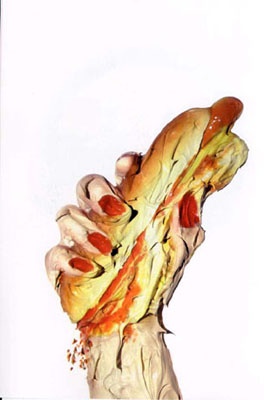
This was an artist that I also discovered on the Alternative Musem site. Although I had seen a few pieces of Genoves work before in some of my previous art classes, I never really knew much about him and his distinct form of medium. What is striking about his work is that it looks (at least to me) to be more sculpture based as opposed to something done completely digitally. Particularly in his piece entitled Hot Dog I felt the depth of what seemed to be to be sculpture because the hotdog and hand itself had a variety of visible textures. I was tricked. It turns out that Genoves uses the computer to come up with these pieces and not clay, plaster or papier-mâché.
Pablo Genoves produces a combination of a great many different artistic disciplines and an intersection of realism and fantasy. The convergence of either familiar appropriation in addition to his own original images with photographs of previously painted canvases and transforms them digitally. These works have the false and somewhat confusing appearance of painting reproductions or sculpture pieces done in a physical studio as opposed to something done on a digital canvas.


Genoves’ work leave me wonder just how he completed his final pieces of art. It makes me wonder how he became interested in the teqnique of changing the way we view elementary sculpture and photography and why it was that he chose to utilize digital media in order for changing the original artwork into something completely different. It seems as though, through his work, he is making a statements about the different mediums in art and how they each add something differently. Obviously for him this must mean that he feels the most freedom in the medium of digitalized artwork as opposed to more conventional ways of producing the painting reproductions that he started out with. He engages the audience in a discussion on the great cycle of art, and how far it has come over the ages. It reminds me a lot of the project mentioned in class in which someone took photographs of photographs and claimed them as their own artwork, merely because of the slight change.

Wednesday, March 4, 2009

FOR NEXT CLASS
Pat says:
Utilize the camera mode, play with the idea of the viewer and how they are incorporated into your project.
Three new animations

FOCUS ON THE CONCEPT OF THE VIEWER!!!

Thursday, February 26, 2009

Alessandro Bavari (Artist Post #5)

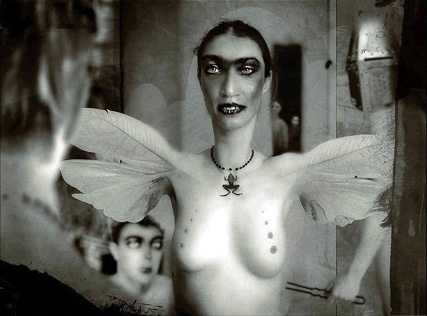
Alessandro Bavari was born in 1963 in Latina, a town bordering the cost on the south of Rome, Italy where he grew up as a member of an Italian-French family. Alessandro Bavari's work is directly correlated with two of the artist I have previously decided to blog about. Although his work is in the same vein as Jacqueline Hayden or even Fran Herbello, there are some stark differences between the two. For one thing, there is nothing subtle about Alessandro Bavari's work. Unlike some of the other artist that I have posted on, he does not attempt to merge seamlessly the pieces of fiction and reality within his work. His pieces are whimsical yet somehow disquieting. The masculine face on the somewhat feminine body in his first piece contrast with one another sharply, leaving me to question what his purpose of doing so was. Also, the distorted bodies of the figures in the background are in stark contrast with their blunt sinister facial expressions. Bavari mismatches everything from focus to our preconceptions of what fantasy is and how reality comes into play within that notion.
Throughout his career Bavari has taken several photographs of people, animals, objects, architecture, landscapes, and fossils. He uses these images as the toolbox for his work, which is greatly influenced by “Indo-European cultural myths and allegories.” His pieces merge several different photographs together. It makes me wonder whether or not Photoshop is the only thing he uses in his creations, and what inspires him to create such odd collages of the separate mosaic photographs that he has taken. His manipulation of many of his own original photographs creates a narrative that he takes as a description of “unconscious urges and desires.”
I’m not quite sure what the urges and desires of the Portrait of nymphomaniacs in Gommorah is exactly attempting to portray, (possibly sex and the desire to fly?), but I found his work to be interesting all the same. I can’t wait until we get started with Photoshop in class! If nothing else, I admire how Bavari’s work is distinctly his unique expression of human desires- he took his own photographs and merged them in photo processing software to create his own inimitable visions.

Thursday, February 19, 2009

What I've got so far!! Please comment.

http://students.smcm.edu/rnali/lovestory.html

Wednesday, February 18, 2009

"Roy Rules. It would be a 24/7 96" (Artist Post #4)

Simen Johan creates a situation in his photography that forces the audience to implicate and use their own experiences as a way of getting into what the piece really means. The first piece that I viewed of Johan’s work was entitled “#96”. I think the anonymity of the piece adds to the artist’s intention of leaving interpretation up to that of the viewer. Usually artist name their artwork, whether it be for symbolic or simply categorization purposes. Johan, however, refuses to do so, and therefore creates only a picture which we must decipher.
Number 96 shows a disorderly un-kept while girl with a bag over her head and an arrow in her left hand. In front of her lies, what seems to me, a bald eagle. She is surrounded by walls that were once white but now remain beaten, scratched and graffitied with monsters and other whimsical characters, along with numbers written backwards. To me, personally, the artwork symbolizes the death of the innocence and purity of a nation, preferably the United States because of the implications that a bald eagle holds as our national bird. The dirtied girl with a bag over her head seems to beg for sympathy and help, as she seems to wither away. The girl can also be seen as responsible for the nation’s death, mostly because of the arrow in her hand, yet she seems blind because of the bag, and helpless because of the daunting walls of horror that surround, entrap and somehow torment her.
Through his photography, Simen Johan questions his viewers and creates “narrative possibilities and allegories that appear vaguely familiar and produce numerous associations” (Johan). Johan further states that it is his hope to “to seduce viewers into letting their experience, imagination, and understanding of existing popular narratives create their own interpretations of my images.” I love the mystifying effect that it creates in and of itself.


"Number 96"

Monday, February 16, 2009

Disturbia (Artist Post # 3)

Jacqueline Hayden

When I saw the disturbing artwork of Jacqueline Hayden I was immediately reminded of the most disturbing scenes that are frequent in horror films. Looking through some of the pictures posted on the Alternative Museum’s website, I began to wonder what it is about the art that is so disturbing. Her art is very realistic and appears to the viewer to be an actual human, at least the photographed work. When I saw her sculpture on the pedestal, it gave her artwork an entire different look and feel. To see people looking up at the piece put things in a new perspective and made the artwork seem somewhat powerful. Staring up at a grotesque human body I think says a lot about a society’s standards and views on culture.
Jacqueline Hayden considers her work creations of digital composites which are photographs of older figure models and photographs made of ancient statuary in situations that usually significantly engage the visual history of aging. The photograph is, according to Ms. Hayden, "by its analog and societal nature a copy, a reproduction of 'something real.' The digital age [however,] is challenging the power of the photograph's veracity. I am attempting, in my Ancient Statuary Series, to question the presumptions of that truth." By creating these implausible images, I feel as though Hayden, through her work, is asking if not forcing her audience to scrutinize what is true and false both in photography and in reality.


I really liked Jacqueline Hayden’s work because it stuck out in my mind, and made me question it, question not only the physical art itself but also what it meant, question not only what it meant but how it was made to signify what it was trying to convey to me. I think it is a wonderful thing when artwork can be so deep and mysterious and quizzical simultaneously.